
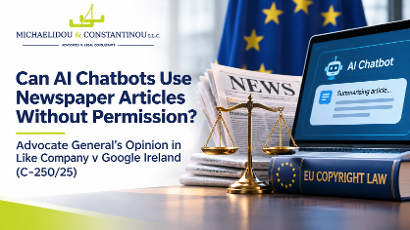


Can AI Chatbots Use Newspaper Articles Without Permission? EU Copyright Law Under Scrutiny
Artificial Intelligence and Copyright: Advocate General's Opinion in Like Company v Google Ireland (C-250/25)
Under European Union law, press publishers benefit from specific rights concerning the online use of their press publications by information society service providers. These rights are provided for under Article 15 of Directive (EU) 2019/790 on copyright and related rights in the Digital Single Market, commonly referred to as the CDSM Directive.
However, an important legal distinction must be made between the use of information and the reproduction of protected content. While copyright does not generally protect facts or information as such, the CDSM Directive provides specific protection for press publications, subject to certain limitations and exceptions.
Against this background, a dispute arose between Like Company, a Hungarian press publisher, and Google Ireland Limited, concerning the alleged unauthorised use of press publications by Google's artificial intelligence chatbot.
On 3 November 2026, Advocate General Maciej Szpunar delivered his Opinion in Case C-250/25, examining important questions concerning the application of EU copyright law to generative artificial intelligence systems.
Facts of the Case
Like Company, a Hungarian company operating online news portals, initiated legal proceedings against Google Ireland Limited before the Budapest Regional Court, alleging that Google's AI chatbot, initially known as Bard and subsequently as Gemini, had used its published articles without authorisation.
In support of its claims, Like Company relied on an example involving an article published on its website concerning a Hungarian singer's proposal to introduce dolphins into an aquarium at Lake Balaton. According to Like Company, when Google's chatbot was asked to summarise that article, it generated a response containing information from the publication.
Like Company argued that Google's activities involved both the unauthorised use of its articles for training AI models and the reproduction and making available of its press publications.
The Hungarian court referred four questions to the Court of Justice of the European Union (CJEU) under Article 267 TFEU, seeking clarification on whether the use of press publications for AI training and the generation of AI responses or summaries may infringe publishers' rights under EU law, and whether the exceptions relating to text and data mining apply.
Advocate General's Opinion – In a Nutshell
Advocate General Maciej Szpunar distinguished between the use of protected publications for AI training and their use in generating responses to users' questions.
1. AI Training
The reproduction of protected publications for the purpose of training AI models may fall within the scope of copyright protection. However, such activities may benefit from the text and data mining exceptions provided under EU law, subject to the applicable legal requirements and limitations.
2. AI-Generated Responses
Where an AI chatbot reproduces protected content from press publications in its responses, such activities may constitute an infringement of publishers' rights, depending on the nature and extent of the material reproduced.
3. Summaries of Published Articles
The mere communication of facts or information contained in a published article does not automatically constitute infringement. However, where an AI-generated summary reproduces protected elements of the original publication, the rights of the publisher may be engaged.
4. The Particular Dispute
The Advocate General did not determine that Google had infringed Like Company's rights. The assessment of the facts and the application of the relevant legal principles to the dispute remain matters for the referring Hungarian court.
Conclusion
The Advocate General's Opinion highlights an important distinction between the use of press publications for training artificial intelligence models and the reproduction of protected content in AI-generated responses.
AI companies are not automatically prohibited from using press publications, but neither are they automatically exempt from copyright liability merely because the content is processed or reproduced through artificial intelligence.
The Opinion is particularly relevant to press publishers, copyright owners and AI service providers, as it addresses the boundaries of copyright protection in an increasingly AI-driven digital environment.
It should be emphasised that the Advocate General's Opinion is not binding and does not constitute the final judgment of the CJEU.
Source: Advocate General Maciej Szpunar, Opinion of 3 November 2026, Case C-250/25, Like Company v Google Ireland Limited.
Disclaimer: This article is provided for general information purposes only and does not constitute legal advice. The legal issues discussed are subject to the applicable legislation, judicial interpretation and the particular circumstances of each case.
Other Articles in the same Series
The "Metaverse Drinks" case R 2356/2022-2

The Glashutte case T-1163/23
virtual goods vs real world goods

The “METAMASK” Case R 1657/2024-1

Artificial Intelligence Systems and Models.

Advocate General's Opinion in Like Company v Google Ireland (C-250/25)
The Intellectual Property Series
"To improve is to change, so to be perfect is to have changed often."
–Winston Churchill
© Copyright MICHAELIDOU & CONSTANTINOU L.L.C